

By Henri Schmidt, CEO & Founder of VBTec/Visionbody, Muscle Expert
What Is Whole Body EMS
I’ve spent years working with EMS technology, refining it, pushing its boundaries, and when I refer to whole body EMS, I mean a method of training where all major muscle groups are stimulated simultaneously using electrical impulses through an EMS suit. This isn’t localized stimulation (one muscle at a time); it’s a full-body approach designed to deliver maximal results in minimal time.
Whole body EMS (WB-EMS) has become one of the most promising approaches for fitness studios. In this article, I’ll explain the method in detail: how it works, how it compares to traditional training, and how business owners can use it effectively.

How Whole Body EMS Works
The Basic Mechanism
Whole body EMS uses external electrical impulses, delivered through electrodes placed over the skin above muscles. These cause involuntary muscle contractions, much like what your brain does naturally, but in a more intense, controlled way. Because we’re stimulating multiple muscle groups simultaneously, the body uses more muscle fibres than in typical workouts.
Key Parameters: Frequency, Duration, Intensity
To get good results, you need to manage:
- Frequency of impulses (Hz)
- Duty cycles (on/off periods)
- Intensidad (how strong the impulses are)
- Session Duration, typical sessions last 20 minutes for WB-EMS.
These variables are essential. If they’re too low, you won’t activate enough muscle; too high, and you risk discomfort or overstimulation.
Benefits of Whole Body EMS (for Business Use)
Time Efficiency & Resource Optimization
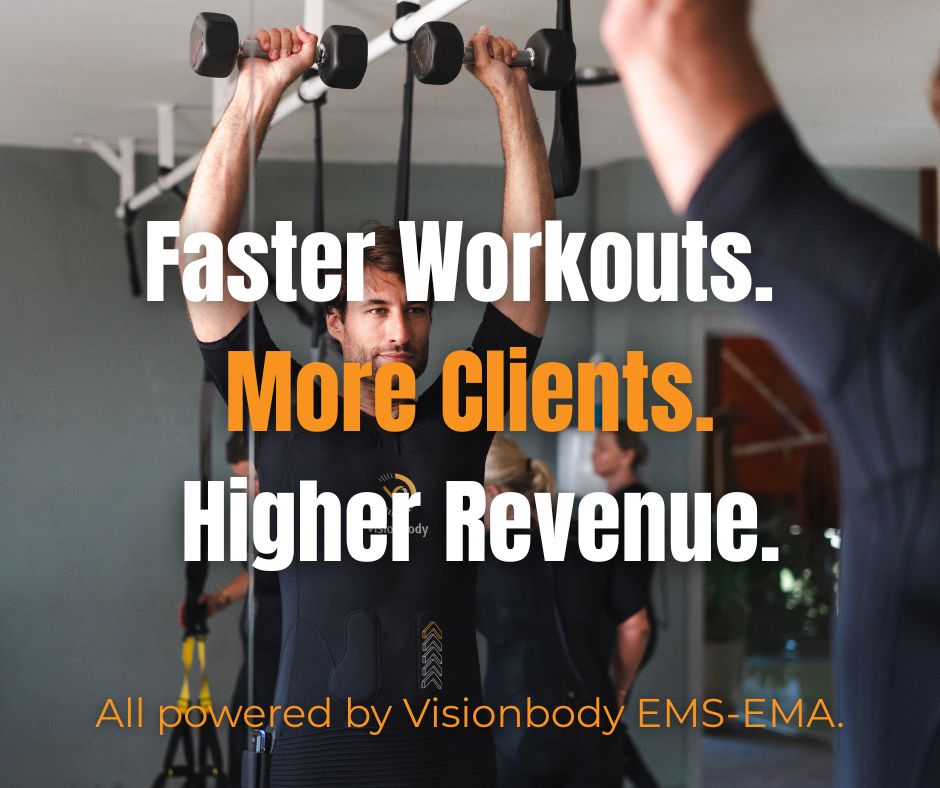
As a studio or gym operator, whole-body EMS lets you offer complete workouts in about 20 minutes instead of over an hour. That means you can serve more clients each day, increase efficiency, and maximize use of your space.
Also, with advanced systems like Visionbody, the whole-body suits are fully wireless and quick to put on and take off. This saves staff time, reduces hassle, and keeps sessions running smoothly.
Hygiene, Safety, and Compliance
Clients today demand hygiene and safety. Whole body EMS systems with dry-electrode, antibacterial suits, minimal shared equipment, and proper FDA clearance are a must.
Broad Client Appeal
Whole-Body EMS training can be adapted to a wide range of fitness levels and training goals, making it suitable for many different types of clients, including:
- Wellness-focused clients
- Adults looking for a time-efficient strength training option
- Busy professionals seeking to fit exercise into a demanding schedule
Because sessions are short and do not rely on heavy external weights, Whole-Body EMS training can be incorporated into a variety of fitness programs, helping facilities offer an additional training option to a broader range of members.
Financial Upside & ROI
From my experience and the data I’ve seen, whole body EMS can increase revenue via:
- Premium pricing per session
- Higher client retention (quick visible results, less time commitment)
- Lower space, equipment, and staff requirements per client
Limitations, Risks & Best Practices
Professional Use of Whole-Body EMS
Like any professional training technology, Whole-Body EMS should be implemented according to the manufacturer’s instructions, appropriate screening procedures, and applicable regulations.
To help provide a consistent and professional training experience:
- Train staff according to the manufacturer’s guidelines.
- Screen clients for contraindications before their first session.
- Follow the recommended training protocols and intensity progression.
- Allow adequate recovery between sessions.
- Maintain and clean equipment according to the manufacturer’s care instructions.
Choosing a reputable manufacturer can help you provide a consistent training experience for your clients while supporting quality and operational standards.
Contraindications & Client Screening
Not everyone is a suitable candidate for Whole-Body EMS training. Before a client’s first session, operators should screen for contraindications in accordance with the manufacturer’s guidelines.
WB-EMS is generally not suitable for individuals with certain conditions, including:
- Pregnancy
- Implanted electronic devices, such as pacemakers
- Epilepsy
- Acute illness, infection, or fever
- Certain cardiovascular conditions or other medical conditions where exercise or EMS may not be appropriate
If there is any uncertainty about a client’s suitability for EMS training, they should consult their physician or qualified healthcare professional before participating.
Best Practice for Studios
To get the best results and minimize risk:
- Use high-quality equipment (wireless if possible, dry or cleaned electrodes)
- Train staff thoroughly in EMS-specific protocols
- Start clients with lower intensity, build up gradually
- Use whole body EMS in conjunction with movement / functional work, not just static sessions
- Maintain strict hygiene (suits, skin contact, cleaning)
How Whole Body EMS Compares with Traditional Training
Efficiency
Traditional strength training typically requires more time and more movements. Whole body EMS can stimulate many muscles at once, reducing the number of separate exercises needed. For busy clients, that’s compelling.
Muscle Recruitment
In conventional training, many muscle fibres, even some deeper ones, are under-activated due to limitations in neural drive. Whole body EMS helps recruit fibres more uniformly. It doesn’t replace resistance, but enhances it.
Low-Impact Strength Training
Because Whole-Body EMS training does not require lifting heavy external weights, many facilities incorporate it as a lower-impact strength training option alongside conventional exercise.
Training programs can be adapted to different fitness levels, goals, and experience under the guidance of a qualified trainer.
Example of Whole Body EMS Training Protocol
Session Structure
- Warm-up: Light mobility or movement
- EMS activation: 20 minutes of full-body stimulation + guided movement
- Cool-down / Stretching / Recovery modalities
Weekly Frequency & Intensity Progressions
Typically:
- Start with 1 session per week for new clients
- Increase to 2 sessions per week after 4-6 weeks, depending on goals
- Monitor intensity closely: what feels like “moderate” should allow for work in subsequent sessions
Customization & Client Profiling
Not all clients are the same:
- Assess fitness level, health history
- Adjust pulse cycles, electrode placement, intensity
- Use data and feedback to adjust the impulses (pain, fatigue, progress)
Whole Body EMS for Businesses: Implementation Strategy
Choosing the Right Equipment

When I founded Visionbody, the core principle was safety and freedom of movement. For your business, aim for:
- Wireless suits or minimal wiring
- Dry or easy-to-clean electrodes
- FDA clearance and TÜV certification
- Supplier training, maintenance support
Staff Training & Client Education
You must have staff who understand how to program sessions, adjust intensity, and monitor the client’s response. Also, clients need to know what to expect in terms of stimulation, soreness, etc.
Pricing & Service Offerings
Model ideas:
- Intro package (first WB-EMS session at a lower price)
- Bundled sessions (e.g., twice weekly)
- Combined WB-EMS + functional movement packages
These help reach broader markets and justify premium pricing.
Marketing & Positioning
When introducing Whole-Body EMS to prospective clients, focus on benefits that are supported by your product, the available evidence, and the user’s experience.
Emphasize messages such as:
- Time-efficient full-body strength training
- Building and maintaining muscle strength
- Supporting an active lifestyle
- Wireless convenience and ease of use
- German engineering and continuous innovation
Common Myths & Misconceptions
Myth: Whole Body EMS is Unsafe
Fact: When used according to the manufacturer’s instructions, by trained operators, and with appropriate client screening, Whole-Body EMS has been studied and is widely used in fitness, wellness, and performance settings.
Choosing a professionally developed system, following recommended training protocols, and ensuring staff are properly trained all contribute to providing a consistent and professional training experience.
Myth: It Replaces Traditional Training Completely
Fact: Whole-Body EMS is designed to complement, not replace, conventional exercise. It combines electrical muscle stimulation with active movement and can be incorporated into strength training programs alongside traditional resistance exercise, cardiovascular training, and sport-specific practice.
Myth: Everyone Gains Quickly
Fact: Results vary. Beginners often see fast change; experienced athletes may have smaller incremental improvements. But with well-designed programs, everyone benefits.
Conclusion
Whole body EMS is, for me, one of the most exciting and time efficient training methods available to professionals today. It delivers more muscle activation per time in a manner that fits modern client lifestyles and business models.
If you run a gym, or a wellness studio, integrating whole body EMS (with the right gear, protocols, and client care) isn’t just a trend, it’s a strategic advantage.
If you want to see how Visionbody’s whole body EMS systems can transform your business, by improving results, reducing time per session, and elevating client satisfaction, let’s talk.